
A Conditional Hedge in a Geopolitical Age
Why Bitcoin reacts to crises differently — and what markets are really pricing

TL;TR
Track record indicates Bitcoin is not a universal geopolitical hedge.
It falls in systemic shocks (pandemics, great-power wars) when liquidity dominates.
It can rise in regional or contained conflicts and trust shocks (sanctions, asset freezes) where financial neutrality erodes without triggering global deleveraging.
Bitcoin hedges loss of monetary control, not conflict itself.
As a geopolitical hedge, it remains conditional, far from absolute.
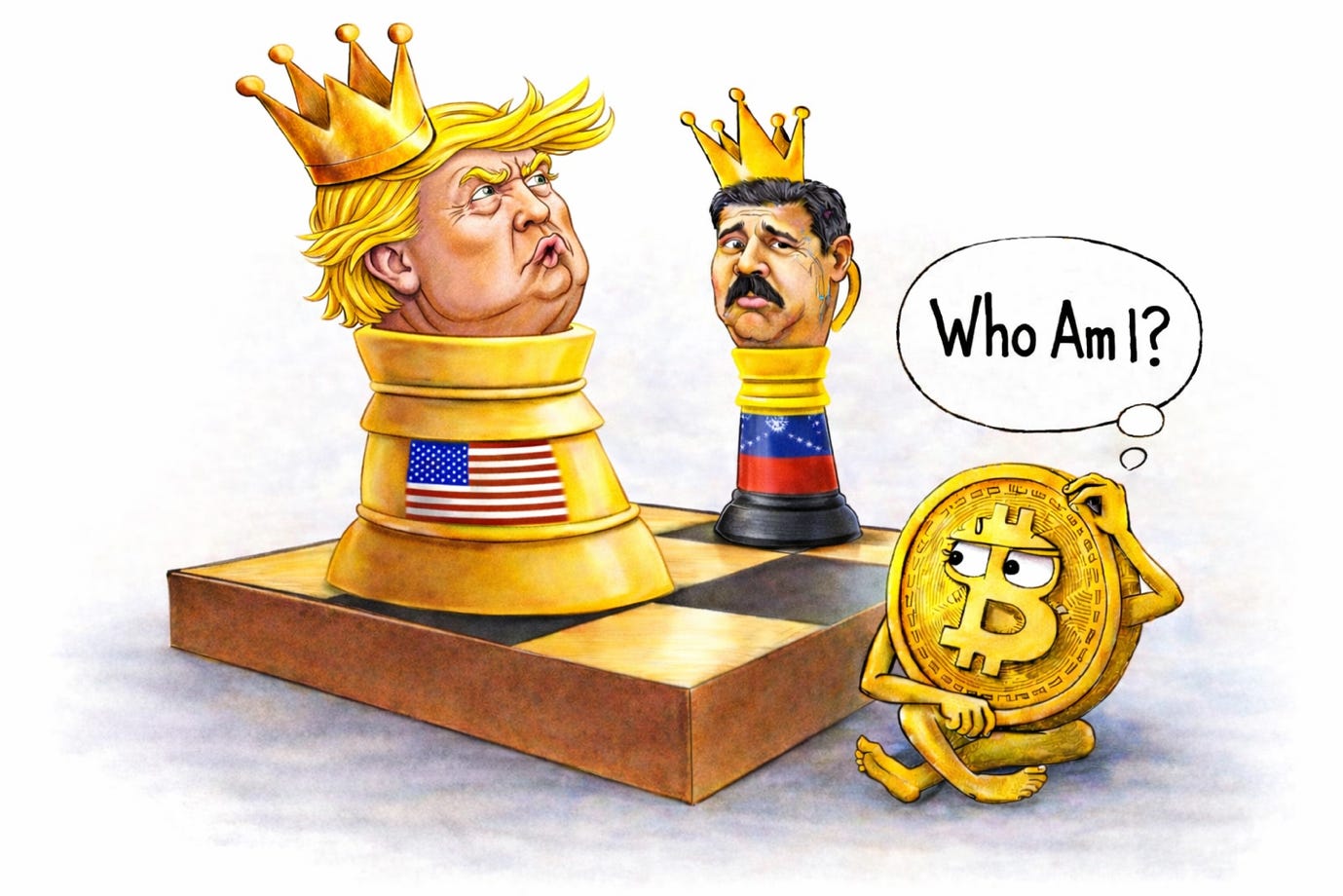
Bitcoin’s recent return to the $90,000 range, after a prolonged period of price suppression and muted momentum, following reports surrounding the capture of Venezuela’s leader, set me thinking once again about a familiar but unresolved question:
Is Bitcoin truly a geopolitical hedge?
Or merely a canvas onto which markets project whatever narrative suits the moment?
The episode revived a thesis many Bitcoin holders have long embraced: that political disruption, especially when it exposes the limits of sovereign power, is ultimately bullish for a non-sovereign asset. Yet history suggests a more complicated story.
To understand Bitcoin’s response to geopolitics, it is not enough to simply catalogue wars and crises. One must ask a more precise question: what kind of stress does each event impose on the global financial system? When that distinction is made, Bitcoin’s seemingly erratic behaviour begins to look conditional rather than contradictory.
I. Systemic Shocks: When Liquidity Dominates
The clearest counterexample to the “Bitcoin thrives in crisis” thesis came at the onset of the COVID-19 pandemic in March 2020. This was, by any measure, a geopolitical and civilisational shock: borders closed, supply chains fractured, and governments assumed emergency powers at scale. Yet Bitcoin collapsed, falling more sharply and more quickly than many traditional assets.
The explanation lies in the nature of the shock. COVID did not initially raise fears of asset seizure or monetary discrimination; it triggered a global liquidity crisis. Investors scrambled for dollars, selling whatever could be sold. Bitcoin, liquid and volatile, became a source of cash rather than a refuge. Only later — once central banks unleashed unprecedented monetary expansion — did Bitcoin recover and eventually surge. Its hedge properties emerged not at the moment of crisis, but in the aftermath, when trust in fiat discipline began to erode.
A superficially comparable but fundamentally different pattern appeared in January 2020, when Iran retaliated for the U.S. assassination of General Qasem Soleimani. Markets briefly panicked over the prospect of a wider Middle Eastern war. Bitcoin spiked initially, only to retrace as the situation de-escalated and risk appetite returned. The episode was too short-lived, and too systemically contained, to sustain a durable hedge bid. Once again, Bitcoin responded not to the symbolism of conflict, but to the shifting balance between fear and liquidity.
The Russia–Ukraine war activated the same underlying liquidity mechanism, but on a far larger scale. When Russia invaded Ukraine in February 2022, Bitcoin fell alongside equities. The war involved a nuclear power, global energy markets, and inflationary shock. The dominant fear was not confiscation, but macro instability: higher rates, tighter financial conditions, and recession. In that environment, Bitcoin behaved like a high-beta risk asset. Only later did its utility emerge locally, as sanctions, capital controls, and payment disruptions pushed individuals toward crypto rails — effects largely invisible in the dollar-denominated price.
II. Targeted Shocks: When Trust Dominates
By contrast, Bitcoin’s strength during episodes involving smaller or more isolated states points to a different regime. Events such as banking crises, sanctions enforcement, or regime instability in peripheral economies tend to foreground questions of sovereign discretion rather than global liquidity.
This is where the recent Venezuela episode fits. Whatever the ultimate political outcome, the market reaction reflected a reassessment of sovereign risk, asset control, and geopolitical alignment rather than a scramble for cash. Bitcoin’s recovery above $90,000 occurred alongside strength in other risk assets and commodities, suggesting not panic, but repricing. In such environments, Bitcoin can trade as a form of optionality: an asset that benefits when the limits of state control over money become salient, but without triggering wholesale deleveraging.
The same logic applies to smaller-scale conflicts, such as recurring tensions between Pakistan and Israel, or regional skirmishes that command headlines without threatening the plumbing of global finance. These episodes may reinforce Bitcoin’s narrative appeal without imposing the liquidity stress that overwhelms it during systemic shocks.
III. Stress-Testing the Thesis: Imagined Futures
The distinction between liquidity shocks and trust shocks becomes even clearer when applied to hypothetical — but not implausible — future scenarios. These thought experiments are useful precisely because they strip away hindsight and force the thesis to operate under uncertainty.
China and Taiwan remains the most obvious case. A Chinese invasion would represent a systemic geopolitical rupture: disruption to global trade, semiconductors, shipping lanes, and great-power relations. The immediate market response would almost certainly be a violent risk-off move. Bitcoin, despite its non-sovereign design, would likely fall alongside equities as global portfolios deleveraged and dollar liquidity was hoarded. In such a scenario, Bitcoin’s hedge properties would not disappear — but they would be deferred. Only once sanctions, capital controls, or financial fragmentation became salient would Bitcoin’s utility narrative reassert itself, and even then unevenly.
Now consider a different, more subtle scenario: the United States invading and occupying Greenland, justified on strategic or security grounds. Unlike a Taiwan conflict, such an action would not immediately threaten global supply chains or trigger a worldwide liquidity scramble. The U.S. dollar would remain dominant; markets might even initially treat the move as stabilising from a narrow security perspective.
Yet the implications for trust would be profound. Greenland is legally part of a NATO ally; its forcible occupation would represent a sharp escalation in the normalisation of power politics among liberal democracies. The signal would not be one of imminent financial collapse, but of precedent: that territorial sovereignty, treaties, and legal frameworks can be overridden by strategic necessity, even by the world’s reserve-currency issuer.
In that environment, Bitcoin’s reaction would likely differ markedly from its response to a Taiwan invasion. There would be no immediate liquidity shock forcing indiscriminate selling. Instead, attention would shift to second-order questions: Which assets remain politically neutral? Which stores of value are truly outside discretionary power? How secure are property rights when geopolitical norms erode?
Bitcoin could plausibly strengthen in such a scenario — not as a panic hedge, but as an insurance premium against the erosion of rule-based order. The market would not be pricing war itself, but the credibility of the system that claims to manage it.
This contrast illustrates the core point. It is not the scale of violence, nor the prominence of the actor, that determines Bitcoin’s response. It is whether the event primarily induces a scramble for liquidity or a reassessment of trust. A U.S. occupation of Greenland would likely fall into the latter category, at least initially, making it a cleaner test of Bitcoin’s political-hedge narrative than many outright wars.
IV. What These Scenarios Reveal
Taken together, real and imagined cases reinforce a single conclusion: Bitcoin is a conditional hedge, not a prophecy. It does not rise because bombs fall, nor because leaders are removed. It rises and falls based on which fear dominates markets at the margin.
When fear is about survival of portfolios, Bitcoin is sold.
When fear is about survival of financial neutrality, Bitcoin is repriced upward.
It is in this second category that the recent Venezuela episode may best be understood. Beyond the immediate headlines, markets were also absorbing a subtler but more consequential signal: Switzerland’s decision to freeze assets linked to the Maduro regime. For a country long regarded as the custodian of financial neutrality, the move still carried symbolic weight. Switzerland had already broken precedent by freezing Russian assets after the invasion of Ukraine. That it was now willing to do so again underscored how quickly exceptional measures are becoming routine and how narrow the remaining space for politically neutral capital has become.
This matters because Bitcoin’s appeal does not rest on chaos alone, but on precedent. Each instance in which neutrality is reinterpreted or abandoned raises a quiet question about where, if anywhere, assets can remain insulated from discretionary power. In that light, Bitcoin’s recovery above $90,000 looks less like a knee-jerk reaction to regime drama and more like a modest repricing of insurance against a shrinking sphere of neutrality.
The persistent error among Bitcoin enthusiasts and critics alike is to collapse these distinct regimes into a single story. History, and imagination, suggest that doing so will continue to mislead.